The social housing sector is undergoing a fundamental shift towards enhanced professionalism in 2026 with the introduction of the Regulator of Social Housing’s (RSH) Competence and Conduct Standard.
 Following a consultation by the Conservative government in February 2024 on the practicalities of implementation, the Labour government confirmed in July 2025 that the Standard will come into force in October 2026.
This sector-wide, outcomes-based framework establishes a comprehensive standard for the social housing workforce in England, defining clear expectations for professional conduct, qualifications, and organisational culture change.
Centrally, the framework mandates that senior professionals responsible for delivering social housing services must hold, or be actively working towards, a recognised housing management qualification.
This requirement serves as a foundation for a broader, essential culture change across the sector. By further professionalising the workforce and enhancing individual competence, the framework aims to tackle systemic stigma and ensure that all staff embody behaviours that supports residents to receive a respectful, high-quality, and professional service.
To facilitate compliance, a phased implementation strategy has been adopted, granting large, registered providers managing over 1,000 units a three-year transition period, while smaller associations will have four years to meet the new requirements.
The discourse surrounding professionalism within the sector has been shaped by poignant evidence from the Grenfell Tower Inquiry and the consultations following the 2018 Social Housing Green Paper.
These investigations revealed a profound breakdown of trust, with residents frequently feeling ignored, excluded from decision-making, and subject to a lack of accountability. Common grievances included sluggish complaint handling, significant skills and competence gaps among staff, and a distressing lack of basic respect and courtesy.
The tragic death of Awaab Ishak further galvanised the movement for reform, illustrating the fatal consequences of dismissive attitudes and insufficient training.
In response, the Social Housing White Paper initiated a comprehensive professionalisation review that underpinned the new Competence and Conduct Standard, concluding that meaningful change required a systemic cultural shift – prioritising respect and high-quality service, not just technical proficiency.
Consequently, the new regulations will now mandate specific qualifications for senior leaders and executives, reflecting a firm belief that professional excellence must be driven from the top to ensure the safety and wellbeing of all residents.
Following the government’s final Direction to the RSH published on 30 September 2025, under the Standard, providers will be required to ensure that all relevant staff possess the necessary skills, knowledge, competence, and behaviours to deliver high-quality services, while also holding contractors to the same rigorous standards.
Organisations must adopt a formal written policy for workforce development and performance management, alongside a robust code of conduct that is regularly updated and integrated into daily operations.
 Adrian Harvey, Chairman and Co-Founder of Elephants Don’t Forget, commented on the transition and explained what the workstream preparation could look like:
“Whilst the sector has a definitive date for enforcement, the transition period offers providers a much-needed window for preparation.
The RSH will be looking for demonstrable evidence of transformation to answer a fundamental question: ‘What has changed in your organisation since the enforcement date?’
There are two distinct workstreams here. The first is the formal qualification requirements for senior leaders; the second – and equally vital workstream –relates to wider workforce competence and cultural improvement.
This is a ‘people project’ that will likely be headed up by HR and L&D, but it must remain cross-functional to succeed in practice.
It is notable that the RSH uses the term ‘competence’, as this challenges providers to define, measure, and credibly evidence it.
The Regulator’s scrutiny will focus on the efficacy of systems and the quality of evidence. They will likely demand tangible proof that training translates into measurable improvements in service delivery, supported by robust gap analyses and clear remediation plans.
Ultimately, compliance is not achieved through one-off training exercises or certificates of learning. This is going to about how providers continually support their staff to identify, repair, and close knowledge gaps on a permanent basis.
HR and L&D can lead the change required to meet these new expectations, but it requires senior leadership support, adequate resourcing, and cross-functional input to ensure that the Standard is woven into the fabric of the organisation.”

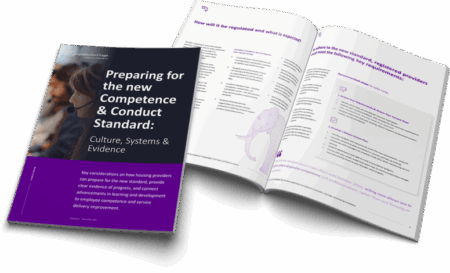
Preparing for the new Competence & Conduct Standard: Culture, Systems & Evidence
This latest e-guide from Elephants Don’t Forget explores how housing associations can effectively prepare their workforce for the forthcoming Competence and Conduct Standard. By focusing on the critical pillars of culture, systems, and evidence, the paper provides essential clarity on how the new standard will be regulated and what the Social Housing Regulator expects in practice.
Designed as a supportive resource for C-suite executives and senior leaders, the guide offers actionable advice across multiple business functions. Whether you are leading Customer Service and Operations, managing Compliance and Risk, or heading HR and Learning & Development (L&D), this paper discusses the framework necessary to align your organisational culture with the new regulatory requirements.
To download the E-Guide Click Here