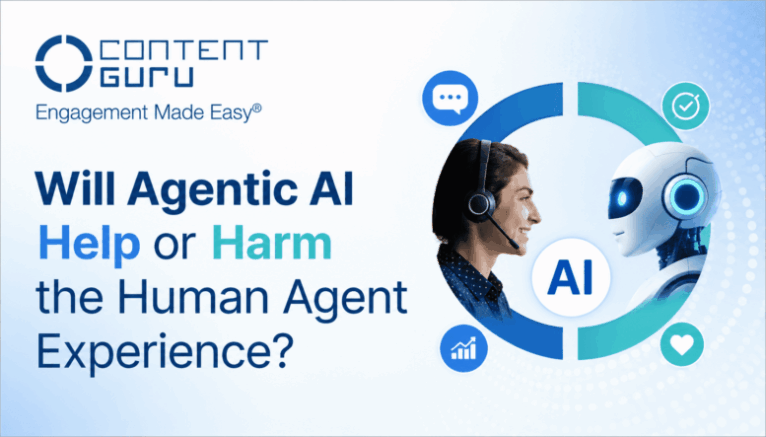
Will Agentic AI Help or Harm the Human Agent Experience? – Martin Taylor, Co-Founder and Deputy CEO of Content Guru disussces the implications for the content centre
There is little doubt that AI is reshaping the job market. The Institute for Public Policy Research (IPPR) estimates that over eight million jobs in the UK could be at risk if AI adoption prioritises automation without sufficient safeguards, particularly in back-office, part-time, and entry-level roles.
Although job displacement can sound alarming, there are also opportunities for job growth, with jobs directly involving AI activities rising from 158,000 in 2024 to a predicted 3.9 million by 2035, equating to 12% of the total UK workforce. Customer Experience (CX) sits on the frontline of this shift, with some hawkish reports predicting that all contact centre agent roles will be fully automated. The reality of the situation is more nuanced, and will more likely be a balance between human and AI in CX as organisations find the best blend to best serve customers while supporting their staff.
With generative AI now widespread within CX and AI development continuing at pace, we are now seeing the adoption of agentic AI capabilities. By implementing agentic AI, organisations can use tools that autonomously reason, plan and execute tasks with the aim of achieving goals, with minimal human intervention.
The rise of agentic AI in CX raises several questions around the future of contact centre work: with fully-automated agentic AI interactions hoovering up all the easy tasks, could human agents eventually be left handling only the most complex, emotionally charged, or difficult interactions? Some fear this could create a “human agent experience crisis”, where the remaining human workload becomes increasingly stressful and undesirable.
However, the reality is likely to be far more positive. When implemented effectively, agentic AI will likely be much more beneficial to its human counterparts, since it works in partnership alongside them. Ways that agentic AI agents will positively improve the human agent experience include:
- Real‑Time Agent Assistance
Agentic AI can create knowledge articles to support human agents during interactions. They can determine customer details and intent, and draw information from different systems of record so that human workers have all the information and context they need. Furthermore, AI can provide real-time next best action based on pre-approved organisational sources, outlining how to resolve the customer’s issues.
It can also pull information from product guides, customer policies and FAQs to provide suggested actions which can be relayed to the customer. As a result, interactions will run more smoothly and benefit the human worker by giving them all of the information they need to achieve a positive outcome, even when that worker is new to the role.
- Agent Support and Development
As well as having the ability to offer real-time guidance through knowledge articles and prompts, agentic AI Agents can also act as coaches or mentors. These agentic AI Agents can monitor all interactions and offer feedback and guidance that feels supportive to the human worker, rather than punitive. Before AI, providing feedback was tricky as supervisors would typically only review a small percentage of interactions, with the review process often taking weeks, if not months.
AI has allowed for auto Quality Analysis (AQM), and the implementation of agentic AI agents can drive value through assistance. The introduction of agentic AI to provide feedback and guidance will leave human agents feeling more confident and valued in their roles.
- Post-Interaction Admin
Agentic AI can take what generative AI started and go one step further to create outcomes. For example, systems of records can be updated, and agentic AI agents can work on next steps, including the creation and scheduling of follow-up emails to customers automatically.
Agentic AI Agents also have the ability to create support tickets and escalate issues, as well as initiate refunds for approval. Humans will still be ‘in the loop’ and oversee the progress agentic AI is making, and they can intervene, if necessary, but crucially, human agents are freed up and able to focus on the more ‘human’ aspects of the role, especially for urgent, complex or emotional interactions.
- Human Agents and Agentic AI in Partnership
Despite narratives around autonomous versions of AI coming for their jobs or diminishing the role of the agent, the growing relationship between the human agent and AI has to be seen as a positive partnership.
Despite increasing automation, humans will still be crucial within CX, and the focus should be on how AI can remove lower-range tasks from human agents and allow them to focus on high-value interactions, which provide great customer service and agent experiences.

 Martin Taylor is Co-Founder and Deputy CEO of Content Guru
Available in over 150 countries, storm® is the only cloud platform trusted to run national blue-light emergency services and its CX solutions have delivered the highest customer satisfaction scores in multiple industries for many of the globe’s largest organisations. Its brain® AI services provide leading automated and human-assist capabilities to bolster contact centre performance.
For additional information on Content Guru view their Company Profile