The Human Touch: Redefining Customer Experience in the Age of AI
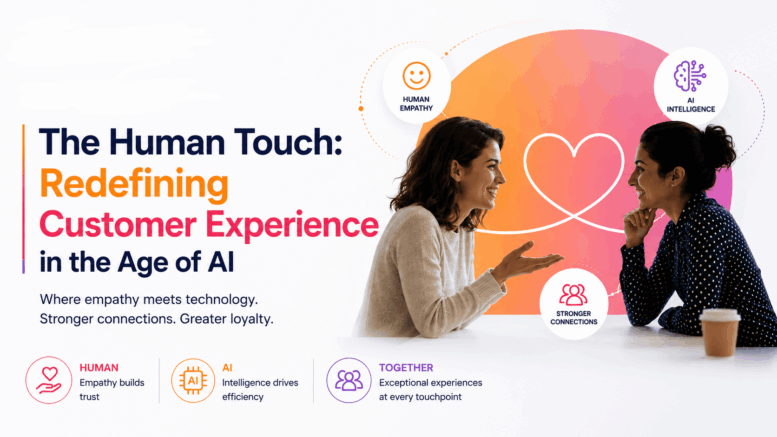
Over the past few years, artificial intelligence has become deeply embedded across customer journeys. Whether it is AI chatbots handling routine queries, automated triage systems or predictive customer insights, companies are racing to adopt technologies that promise a faster, more efficient service.
This is not surprising considering speed and convenience have defined strong customer experience for years. Consumers wanted rapid responses, seamless digital journeys and minimal friction. These expectations remain important, but the tide is turning. With AI becoming more visible in day-to-day interactions, customer expectations are now evolving towards something more nuanced: authenticity, trust and human connection.
Now, leaders are increasingly questioning whether automation alone is enough to foster loyalty. We’ve spoken with three experts about finding the right balance between AI efficiency and meaningful human engagement.
From Efficiency to Authenticity
 According to Paul Thomas, Senior Vice President, EMEA at Acclaim, the industry is reaching a turning point.
“For years, customer experience has prioritised speed and efficiency but now expectations are shifting,” he says.
“Customers still value convenience, but they also want experiences that feel trustworthy, transparent, and genuinely human.”
That trend is forcing organisations to rethink how AI is integrated into their customer journeys. While automation can improve speed and consistency, many businesses are discovering that poorly implemented AI can also create interactions that feel impersonal or disconnected.
“The next phase of customer experience will be defined by precision,” Thomas explains. “That means applying AI to specific, high-impact scenarios where it can drive real outcomes, from faster resolution to more meaningful engagement.”
 For contact centres in particular, the focus is increasingly moving towards using AI to remove friction while maintaining continuity across the customer journey. Jay Fitzhenry, Technology & Innovation Director – Digital at Node4, points to AI-powered triage as one of the most effective examples.
“AI agents can support in resolving a query as soon as it arises or escalating the issue to a human agent if the request is more complex,” he says. “This approach ensures customers receive help in a timely manner with a level of expertise that befits the situation.”
Connecting Customer and Employee Experience
At the same time, AI is helping organisations create more joined-up experiences behind the scenes.
“Using an AI-powered contact centre solution that integrates directly with an organisation’s CRM, agents are provided with all customer information and previous contact history at the beginning of an interaction, removing any friction when customers are transitioned between agents or even contact channels. For customers, this means consistency and a high standard of service,” Fitzhenry explains.
That consistency is becoming increasingly important as economic pressures reshape customer expectations around value and loyalty. With household budgets remaining under strain and businesses facing continued pressure to reduce costs, customers are becoming more selective about the brands they trust. Speed and price still matter, but customers also want reassurance that organisations understand their needs and can deliver experiences that feel accountable and authentic. For many organisations, that puts renewed focus on the employee experience behind customer interactions.
 Mark Williams, Managing Director EMEA at WorkJam, said,
“A truly exceptional customer experience begins with the people leading it on the ground,”
“Frontline managers play a critical role in shaping the employee experience day to day – setting the tone, removing friction, and enabling their teams to deliver the moments that customers remember long after the interaction ends.”
Williams believes businesses risk undermining customer experience when employee engagement is deprioritised in the pursuit of efficiency. He says: “In the current economic climate, frontline businesses face mounting pressure to cut costs, but sidelining employee engagement is a false economy. Engaged teams are fundamental to delivering strong customer experiences.”
AI as an Enabler, not a Replacement
By now, many organisations have realised that AI works best as a support tool rather than replacing humans entirely.
“What leading organisations are recognising is that AI is not meant to replace human interaction, but enhance it,” says Acclaim’s Thomas. “The most effective customer journeys are those where AI handles high-volume, routine interactions with speed and accuracy, but then seamlessly hands off to human agents when judgement, empathy or complexity is required.”
That collaborative model is also changing the role of contact centre employees themselves. Rather than replacing agents, AI is increasingly being used to equip them with better information, faster access to customer insights and more efficient workflows. In practice, this can reduce repetitive administrative tasks and allow employees to focus more on higher-value interactions.
“Even if AI can’t resolve a customer issue itself, it remains valuable as a ‘co-pilot’ to human agents,” adds Node4’s Fitzhenry.
The human element remains particularly important on the frontline, where customer perceptions are often shaped directly by employee engagement and support. WorkJam’s Williams points to Gartner’s concept of “Total Experience”, which recognises customer and employee experience as fundamentally interconnected.
“It highlights that customer and employee experiences are two sides of the same coin, and that you can’t improve one without investing in the other,” he says.
For frontline organisations, that means ensuring managers and employees have access to the communication, scheduling and operational tools needed to support customers effectively.
“When managers are supported, their teams – and ultimately their customers – feel the difference,” Williams adds.
Trust as the defining factor
Trust is becoming more and more important in modern customer experience strategies. As consumers become more conscious of how their personal data is collected and used, organisations face growing pressure to ensure AI systems remain transparent, secure and reliable.
“Trust is becoming a defining factor,” says Acclaim’s Thomas. “Organisations need AI systems with built-in guardrails, full transparency, and control over how data is used, ensuring every interaction is efficient and accountable.”
Despite some lingering concerns around AI adoption, Fitzhenry argues that businesses cannot afford to ignore the technology altogether.
“Those who lack the same capabilities as their competitors will not be able to provide the same levels of support, resulting in reduced engagements, damaged brand reputation and loss of customers,” he says.
The Path Forward
Ultimately, the future of customer experience will be determined by how effectively organisations balance automation with authenticity, and efficiency with empathy.
The businesses succeeding are likely to be those that deploy and use AI most thoughtfully and recognise customer experience is not only about increasing efficiency but about creating interactions that feel responsive, authentic and human. Even in increasingly digital environments. Technology alone does not build loyalty. Meaningful customer relationships still depend on trust, transparency and the people behind the experience.
As Acclaim’s Thomas concludes: “The brands that will lead in customer experience are those that strike the right balance: combining the scale and efficiency of AI with the empathy, oversight, and trust that only well-designed human-AI collaboration can deliver.”