The five things CX leaders keep saying about AI – and what they really mean – Stephen Murray at IPI reveals.
In almost every conversation we have with CX leaders at the moment, AI comes up early – and it rarely comes up simply.
Sometimes the pressure is coming from the board, which has seen a competitor announcement and wants a response. Sometimes it’s coming from a vendor demo that raised as many questions as it answered. Sometimes it’s a more fundamental uncertainty: a sense that the market is moving quickly, and that falling behind carries its own risks.
What’s consistent, across sectors and organisation sizes, is that AI feels like something that is happening to organisations rather than something they are actively shaping. That gap between external pressure and internal readiness is where most of the confusion – and most of the risk – tends to sit.
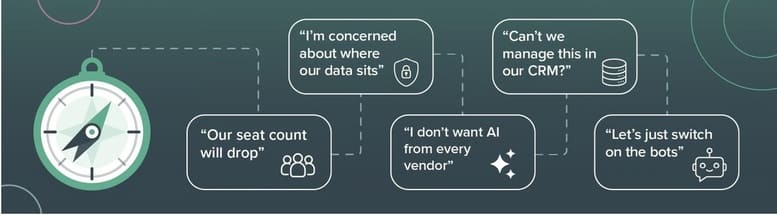
Over the past year, we have been working with CX leaders across a wide range of environments, and five concerns keep surfacing in remarkably similar forms. Each one is worth taking seriously. Each one is also worth examining carefully, because the way it is typically framed doesn’t always reflect what is actually happening in the market – or what a practical response looks like.
Here is our perspective on all five.

1. Will AI reduce contact centre headcount? What the evidence actually shows
“Our seat count will drop.”
This is the concern that tends to dominate boardroom conversations about AI, and it cuts in two directions simultaneously. For some leaders, a reduction in headcount is the goal, framed as the primary business case for AI investment. For others, it is the fear: the thing that needs to be managed carefully before any AI programme can move forward with workforce confidence.
In practice, the current evidence supports neither outcome as an immediate reality.
Only 35% of UK CX leaders have a clearly defined long-term AI strategy.
Most organisations are still in the early stages of understanding how AI can be applied effectively.
What we are seeing, consistently, is AI being introduced to stabilise operations rather than reduce them. The primary use cases are around managing demand variability, providing real-time support to agents, and improving consistency of service delivery. AI is addressing capacity constraints and filling gaps – not replacing the people who handle complex, high-value interactions.
That is not to say the workforce question disappears over time. Hiring patterns will shift, and the nature of certain roles will evolve as AI capabilities mature. But organisations that are building their AI business case around immediate headcount reduction are likely to find that the evidence does not yet support it – and that pursuing this framing creates unnecessary uncertainty for the teams they need to bring along with them.
The more useful question, in our experience, is not how many seats AI can remove but where it genuinely adds capacity and how that capacity can be directed toward better customer and employee outcomes.
In practice: The near-term opportunity lies in augmentation — using AI to enhance performance and resilience, and building the evidence base for more significant change over time.
 2. Data sovereignty and AI in contact centres: why governance comes first
“I’m concerned about where our data sits.”
This concern has shifted considerably in the past 18 months. Data sovereignty used to sit primarily with legal and compliance teams, surfacing during procurement cycles and then receding into the background. It is now a strategic consideration — one that is shaping technology decisions, vendor relationships, and long-term architecture choices in ways that were not anticipated even a few years ago.
95% of UK IT decision-makers report concern about data sovereignty.
What was once a compliance consideration has become a core element of CX strategy.
As AI becomes more embedded in customer interactions, the questions around data become more layered. Where is customer data being processed? Who has access to the outputs generated by AI models? What are the implications – commercially, legally, and reputationally – of that data being used to train or improve third-party systems? These are not edge-case questions. They are ones that any organisation deploying AI at scale in a customer-facing environment needs to be able to answer clearly.
The honest reality is that many organisations cannot yet answer them – not because they have been careless, but because the pace of AI adoption has outrun the governance frameworks that should accompany it. Capabilities have been introduced, often at speed, without a complete picture of the data flows underneath them.
Here at IPI, we are seeing a growing number of CX leaders take a more considered look at their architectural dependencies – including their reliance on large global cloud providers. This is not about distrust. It is about ensuring that flexibility and control are built into the design, so that as the regulatory and commercial landscape continues to shift, organisations are not locked into positions they cannot easily move from.
In practice: Data governance is no longer a supporting consideration in CX strategy. Understanding where your data sits — and how it moves — needs to come before decisions about where AI fits.
 3. Managing AI fragmentation in the contact centre: the case for orchestration
“I don’t want AI from every vendor.”
This is perhaps the most underappreciated challenge in CX technology right now. The market has responded to enthusiasm about AI by embedding AI capabilities into virtually every product category. Every CCaaS platform, every CRM, every workforce management tool now has an AI narrative — and in many cases, multiple AI features delivered through multiple underlying models.
Only 32% of UK contact centres are currently experimenting with AI.
The majority are watching carefully, and asking harder questions about integration before committing.
For organisations that have been acquiring these capabilities across vendors, the practical result is fragmentation. Different tools, different governance requirements, different outputs — all touching the customer journey at different points, with no coherent thread connecting them. The risk is not that any individual capability is poor. The risk is that they do not work together, and that the customer experience reflects that disconnect.
We are seeing the focus shift, as a result, toward orchestration. Rather than adding AI capabilities at the point solutions level, organisations are asking how AI can be introduced within a more unified interaction layer — one that brings together channels, workflows, and AI functionality under consistent governance, and allows the customer journey to be managed as a whole rather than in fragments.
This is a more considered approach, and in our experience it is the right one. The question organisations benefit most from asking is not which AI features are available from which vendors, but how AI can be applied coherently within an architecture that gives them genuine control.
In practice: The priority is not access to more AI, but the ability to apply it consistently — within an environment that is designed for integration rather than accumulation.
 4. CRM vs contact centre platform: where AI changes the architecture question
“Can’t we manage this in CRM?”
It is a reasonable question, and one that reflects how CRM has been positioned — as the system that holds customer knowledge, and therefore the system best placed to direct the customer experience. For many organisations, significant investment has gone into CRM platforms, and the instinct to extend their use rather than introduce something new is understandable.
The challenge is that modern customer experience has evolved beyond what CRM was designed to do. CRM is a system of record — it stores what has happened, maintains relationship history, and supports longer-term workflows extremely well. What it was not designed to manage is the live customer interaction: the real-time orchestration of voice, digital channels, and AI-enabled workflows simultaneously, in environments where urgency, context, and channel complexity all need to be handled together.
These are fundamentally different problems, and they require different tools. What we are seeing in practice is the emergence of a dedicated engagement layer — sitting alongside or above CRM, managing the live interaction, and feeding outcomes back into CRM as a structured record. In this model, CRM remains essential. It continues to do what it does well. But the centre of gravity for managing the customer experience shifts toward the interaction layer, where real-time decisions are made.
This reframing — from CRM as the directing system to CRM as a supporting one — represents one of the more significant architectural shifts in CX right now. Understanding where that boundary sits, and designing for it deliberately, is becoming a meaningful competitive advantage for organisations that get it right.
In practice: If your CRM is currently doing double duty as your interaction management platform, it is worth mapping where the boundaries of its capability actually lie. In most cases, the gap between what it can do and what modern CX requires is larger than expected.
 5. How to approach contact centre AI automation without getting ahead of your readiness
“Let’s just switch on the bots.”
This is the statement that most consistently signals a gap between executive expectation and operational reality. The assumption behind it — that AI automation is a configuration decision rather than a programme of change — is one that tends to surface when the vendor conversation has moved faster than the internal readiness assessment.
AI adoption in customer experience is shaped by a combination of factors that are easy to underestimate from the outside: cost models, data quality and accessibility, integration complexity, and the specific characteristics of the interactions being considered for automation. In many environments, and particularly those with offshore or hybrid delivery models, automation is not automatically the lowest-cost option once all of these factors are properly accounted for.
Over 50% of UK contact centres plan to deploy agent assist within 2 years.
Adoption is growing steadily — but the organisations making real progress are taking an incremental, use-case-led approach.
That is not an argument against automation. It is an argument for precision. The organisations that are making the most meaningful progress with AI are those that have taken the time to identify specific, well-defined use cases — interactions that are high in volume, consistent in nature, and clear in terms of what a good outcome looks like — and have built their AI programme from that foundation rather than from a broad transformation ambition.
Incremental, outcome-driven adoption can feel less ambitious than the language that often surrounds AI investment. In our experience, it is consistently more effective — because it creates a body of evidence, builds internal confidence, and allows the programme to scale on the basis of what is actually working.
In practice: Before the next vendor conversation, it is worth taking time to define the use case clearly: what interaction type, what success metric, what good looks like at 90 days. That clarity tends to make everything that follows — including the vendor conversation — considerably more productive.
What the patterns tell us
Taken together, these five concerns describe an industry that is neither resistant to AI nor uncritically enthusiastic about it. What we are seeing is something more considered: organisations that are genuinely trying to work out how to apply AI in ways that are sustainable, governable, and grounded in operational reality.
The organisations making the most progress tend to share a few characteristics. They are not necessarily the ones moving fastest. They are the ones that have been clearest about what they are trying to achieve, most deliberate about how AI fits within their existing architecture and governance, and most willing to start with a contained use case and build the evidence before scaling.
That is a less dramatic narrative than transformation at scale. But it reflects what is actually happening across the market — and it is the approach that tends to produce results that hold up over time.
How we approach this at IPI
These are not abstract observations. They are the conversations we are having with clients and prospects every week, across a wide range of sectors and organisation types.
Our work is focused on helping organisations design CX environments that can absorb AI incrementally — without requiring them to start from scratch or compromise on governance and control. That means working to understand what is already in place, where the genuine gaps are, and what improvements will deliver the most value at each stage of the journey. It means helping organisations build the interaction layer that makes coherent AI adoption possible, integrated with the systems they already depend on.
It also means being straightforward about what is and is not ready. If the data architecture needs work before a particular AI use case can be deployed safely and effectively, that is an important thing to understand early. If the business case needs refining before it will hold up to scrutiny, it is better to address that at the outset than to discover it later. We find that this kind of honest, practical engagement tends to build more productive long-term partnerships than leading with capability and working backwards to justification.
The immediate priority for most organisations isn’t transformation — it’s clarity
If you are currently under pressure to define your AI strategy — from the board, from technology partners, or from the pace of change across the market — the most useful starting point is often a set of straightforward questions.
– Where does AI genuinely address a problem we have, rather than a problem we have been told we should have?
– Is our data architecture ready to support it safely and effectively?
– Can we govern it in a way that gives us — and our customers — genuine confidence?
– What does a successful outcome look like at 90 days, not just at the end of a multi-year roadmap?
Organisations that can answer these questions clearly are in a much stronger position — not because clarity is the end goal, but because it is the foundation on which effective AI adoption is built. The ones that cannot, regardless of how ambitious their AI plans are, tend to find that ambition runs ahead of the conditions needed to realise it.
If it would be useful to think through these questions with a team that has experience of working through them across a wide range of CX environments, we would be glad to have that conversation.
increased scrutiny, more than half would still need 3-4 working days to retrieve evidence of a single customer interaction.
That’s why we believe the next stage of readiness isn’t about policy. It’s about operational capability.

 Stephen Murray is IPI’s CX (Customer Experience) Solutions Director.
IPI enables brands to meet their digital transformation goals with creative and innovative contact centre, cloud and connectivity services and solutions, which are proven to drive exceptional customer and employee experiences, as well as better business outcomes and increased revenues.
Its team of experts add value at every part of the transformation journey, by providing bespoke consultancy services, training and enablement programmes, DevOps and integration, as well as a range of proprietary solutions and managed services, spanning the Contact Centre, automation and AI, workforce engagement, security and compliance, speech and text analytics, voice services, cloud, and outsourced IT.
Founded in 2001, with its headquarters in Reading and offices in London, Manchester and the Philippines, IPI’s clients include some of the biggest brands in the finance, insurance, retail, travel and leisure, utilities, higher education, and public sectors.
For additional information on IPI view their Company Profile