Same customer, different query: why the task decides who wants AI
 Every AI business case contains, somewhere, a picture of the customer who will use it. Usually that customer is young, digitally fluent and mildly allergic to the telephone.
ContactBabel’s survey of 1,000 UK consumers for the 2026 UK Customer Experience Decision-Makers’ Guide suggests that picture is only half right.
Who says yes
Asked in which situations they would prefer to deal with AI rather than a person, 62% of UK consumers named at least one. The most popular by a distance is a quick answer to a simple question, chosen by at least half of every age group under 55 before falling to 38% of 55-64s and 26% of the over-65s.
The other reasons are more sharply divided by age. 32% of 16-24s would use AI to contact an organisation outside normal hours against 11% of the over-65s, and 26% of the youngest group would choose it simply because they’d rather not talk to a person, compared with 8% of the oldest.
40% of 25-34s would pick AI to skip the queue, more than twice the proportion of over-65s (19%), despite the older group presumably having spent more time than the others listening to hold music.
Who says no
At the other end, 52% of 55-64s and 66% of the over-65s would never choose AI over a person in any of the situations offered, against 16% of 16-24s and 13% of 25-34s.
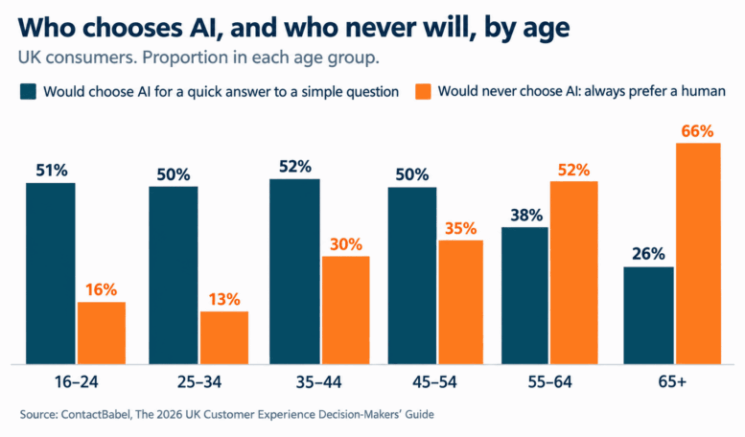
Socio-economic group matters less than age: half of ABs would use AI for a simple question against 31% of DEs, although even among DEs, 52% can name at least one situation where they’d prefer it.
The task decides
This is where the stereotype comes unstuck. Consumers were asked which channel they’d use for an emotional issue (the wrong item arriving), an urgent one (checking the arrival time of a flight they’re meeting) and a complex one (guidance on a mortgage application or tax form).
For the urgent lookup, website self-service is the first choice at 36%, and preference for it rises with age: 25% of 16-24s would self-serve, against 47% of 55-64s and 41% of the over-65s. The customers most likely to say they would never prefer AI are among the most likely to check a flight time online without speaking to anybody.
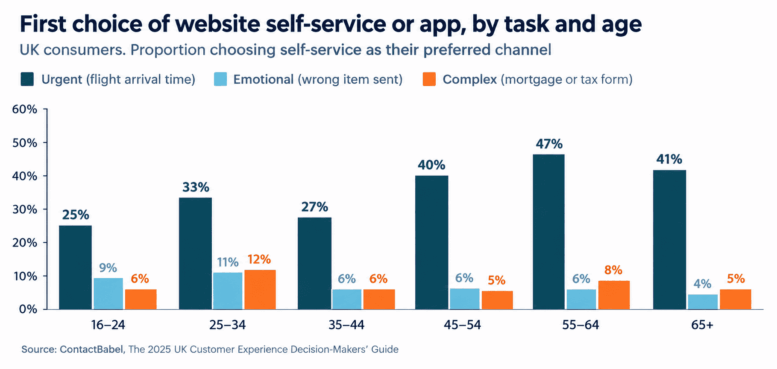
For the emotional and complex scenarios, self-service barely registers in any age group, at 7% overall in both cases. Even among 16-24s, the supposed natives of automation, only 6% would self-serve a complex enquiry, while 37% would ring and 12% would visit a branch or office.
So the AI customer is defined far more by what they’re trying to do than by when they were born. An over-65 checking a flight time is a self-service customer; a 22-year-old trying to make sense of a tax form isn’t.
What to do with this
Two practical points follow.
1) Customers who say they’d never use AI will happily use a fast, accurate lookup, so describe the service by what it does (track your delivery, check your claim) rather than by what powers it, while still being clear that it’s automated.
2) The people most willing to self-serve a simple lookup are also the most likely to want a person the moment it stops being simple, so the route to a contact centre agent has to be obvious from the start. The table below sets out where AI self-service fits and where it doesn’t.
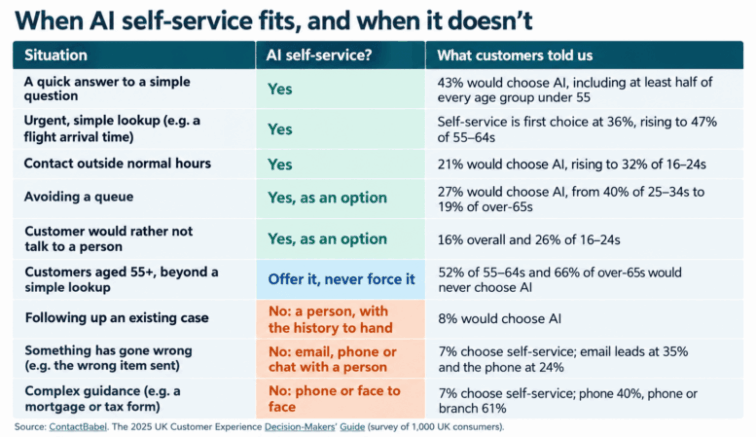
The case for automation is strong wherever customers will choose it, which on this evidence covers a great deal of simple, urgent and out-of-hours contact. Put it there, keep people where customers expect to find them, and the elusive “AI-native customer” turns out to be most of your customers, some of the time.

Steve Morrell is Principal Analyst at ContactBabel.
The 2026 UK Customer Experience Decision-Makers’ Guide is free to download by Clicking Here
“AI in UK Contact Centres: The Reality” is free to download by Clicking Here