How businesses can make the most of AI in customer service solutions
Customer service is changing. As AI capabilities have increased, research from Gartner has revealed that AI spending by customer service leaders has grown by 38%.
However, the question for many is: just how effective are AI technologies? Over the last year, we have seen AI in a range of use cases, from website chatbots to supermarket check-out assistants, with varying degrees of success.
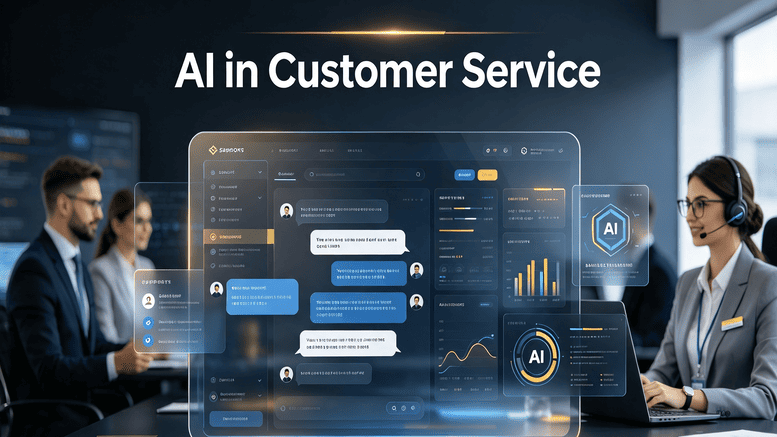
As more organisations look to implement AI, industry experts consider where it can make a meaningful difference to customer service – and what businesses need to get right before introducing it.
Build upon the fundamentals
 With or without AI, customer service must be a 24/7 offering. Rob Shaw, GM EMEA at Fluent Commerce, warns that customer service is “often treated as something that only needs addressing after a customer reaches out for help. However, in reality, the customer experience starts much earlier, from the moment a retailer tells them whether an item is available or promises when it will arrive.”
Shaw see how retailers can overlook much of the customer service experience, only focusing on the more visible aspects such as the website or helpline. He argues that “a polished front end cannot make up for a poor experience caused by inaccurate stock data or disconnected fulfilment processes. And given that one poor experience can be enough to damage customer trust forever, retailers cannot afford to be getting this wrong.”
 Richard Simpson, Chief Solutions Officer at Route 101, echoes this sentiment, highlighting that “with so much attention on AI, it can be easy for businesses to get caught up in the hype and focus only on the latest technology when it comes to customer service. But the basics remain the same: customers want to be able to get in contact and have their issue resolved quickly and easily without being passed from team to team. Technology is only valuable if it helps deliver those outcomes. A chatbot or automation tool may seem innovative, but without access to the right information, or a clear path to a human agent when needed, it can simply create another layer of frustration.”
The advice is clear. Organisations must ensure they focus on building the core foundations before integrating AI. “Good customer service means perfecting the fundamentals,” Shaw explains, adding that, when it comes to retail, if businesses “connect inventory, orders and fulfilment in real time, they can keep their promises, give service teams the information they need and respond more flexibly when something changes.” Only once these boxes are ticked should businesses look to AI to enhance their offering and provide efficient and effective customer service 24/7.
Transforming the modern contact centre
 One of the areas seeing the greatest AI-driven change is the contact centre. This is recognised by Rodney Hassard, Head of Product, Applications Group at Vonage,who explains that “the contact centre is undergoing a fundamental shift.
Today, up to 30% of interactions are automated, with 15–20% of those fully self-served. That figure is projected to grow to 80%, a trajectory that demands a new conversation: not about the role of humans, but about the transformative power of intelligent automation.”
 In the face of this industry change, Jay Fitzhenry, vCTO at Node4, cautions businesses about holding back on AI implementation. “To remain competitive, contact centres can’t bury their heads in the sand,” he insists. “Starting out on an AI journey can be a daunting task, but they don’t have to go it alone – with the right technology partner to guide them, they can fully upgrade their systems and upskill their workforce to ensure they are operating on a competitive level. When it comes to AI, the situation is clear – the risks of non-adoption are simply too high to overlook.”
AI-powered customer service
So, the fundamentals are in place and the pace of change is clear – but what actually are the benefits of adopting AI Vonage’s Hassard envisions that “AI will take on a growing share of tasks once handled by humans, and its capabilities will only expand as the technology matures. But the starting point should always be the problem you are trying to solve. Deploying AI against the right use cases is what unlocks its real value.”
When it comes to triaging customer enquiries, Node4’s Fitzhenry sees AI playing a central role, explaining that “AI agents can support in resolving a query as soon as it arises or escalating the issue to a human agent if the request is more complex. This approach ensures customers receive help in a timely manner with a level of expertise that befits the situation. Even if AI can’t resolve a customer issue itself, it remains valuable as a ‘co-pilot’ to human agents. Using an AI-powered contact centre solution that integrates directly with an organisation’s CRM, agents are provided with all customer information and previous contact history at the beginning of an interaction, removing any friction when customers are transitioned between agents or even contact channels. For customers, this means consistency and a high standard of service.”
However, companies must not allow themselves to be swept up in the hype. Route 101’s Simpson counsels that it is only when AI is used strategically that it can make a meaningful difference to customer outcomes. While he agrees the technology “can assist your agents, automate routine inquiries and provide insights to improve operational efficiency,” he concludes that “the most successful organisations will be those that start with the challenges affecting customers and employees, then apply technology where it can make a measurable difference. The goal should be better service, not AI for AI’s sake.”