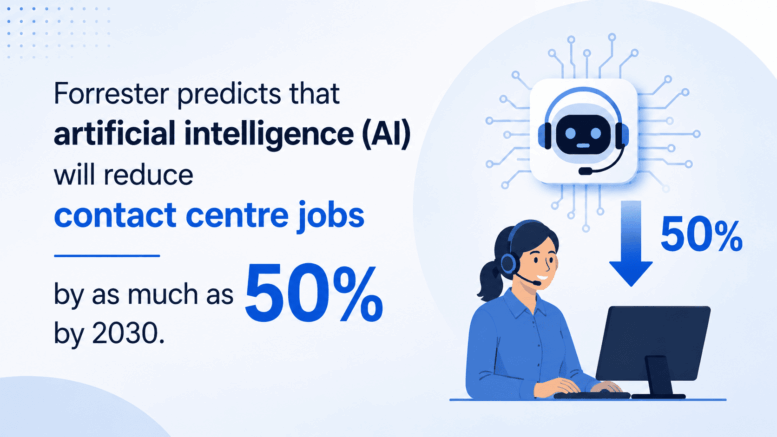
Forrester predicts that artificial intelligence (AI) will reduce contact centre jobs by as much as 50% by 2030.
According to a report released by the analyst firm Forrester, contact centres that handle a large volume of routine, low-complexity customer inquiries are expected to experience the most significant workforce reductions. Contact centres that manage more complex customer issues will also see staffing declines, although at a slower pace.
“There are humans today doing jobs that don’t require the level of intelligence that a human has,” said Max Ball, principal analyst at Forrester. “That work is going to go away, so the number of agents is going to go down, and over time the automation is going to get more and more sophisticated.”
Industry Outlook
As AI adoption accelerates, experts agree that the technology will fundamentally transform contact centre operations. However, opinions differ regarding how quickly and extensively these changes will affect employment.
While Forrester forecasts substantial workforce reductions, analyst firm Gartner takes a more cautious view. Gartner predicts that by 2027, half of the organisations currently planning major contact centre headcount reductions due to AI will abandon or scale back those plans.
Despite differing forecasts, analysts generally agree that customer service roles focused on repetitive, low-complexity tasks are the most vulnerable to automation. For example, customers seeking basic account information, such as account balances, can increasingly be served without human intervention.
Forrester illustrated this trend with a model contact centre employing 1,000 customer service representatives. Within four years, the company could potentially reduce that number to just 40 representatives. At the same time, the firm expects contact centres to create new positions, including relationship managers, industry specialists, and subject-matter experts, to support more complex customer needs and oversee AI-driven operations.