AI rollout in financial services risks worsening access for those who need it most, leaders admit that Financially vulnerable people are struggling to access support from financial services firms, with nearly three-quarters (74%) admitting they have felt like giving up while trying to get help from their bank, insurer or provider, with a quarter (26%) abandoning their attempt to get help entirely.
New research by ArvatoConnect – which surveyed 1,000 senior decision-makers across UK banks, insurers, fintechs, building societies and credit providers – reveals that badly implemented AI could be amplifying the problem.
The data shows a growing disconnect between how firms are designing AI-driven customer journeys, and the realities faced by those in need of support. In fact, more than three-quarters of finance leaders (77%) believe their own AI strategies risk harming vulnerable customers; 28% believe this risk is high.
Rapid AI adoption outpaces safeguards
Leaders are acutely aware of the challenges AI can pose to vulnerable customers*. Nine in ten (90%) believe AI has the potential to exacerbate bias and digital exclusion for customers who need the most support and yet only 23% feel confident their approach to implementing it poses little or no risk. Just 6% believe their approach poses no risk.
But there’s pressure to adopt or get left behind.
Almost nine in ten (88%) financial services organisations have increased their use of AI in customer-facing operations over the past 12 months, with four in ten (41%) reporting a significant increase.
Financially vulnerable stuck in AI doom loops
This risk finance leaders cite is already being felt.
When contacting their financial services provider for help, more than a third (35%) of financially vulnerable customers were only able to reach a human after significant effort, including navigating automated systems and enduring long waits; a further 15% couldn’t reach a human at all. Just 23% say they were able to access a human easily, with the rest not having recently contacted their provider for support.
A similar number (52%) say AI or automated systems rarely or never resolve their issue without them having to escalate to a human, while just 2% say automated systems consistently provide the answers they need.
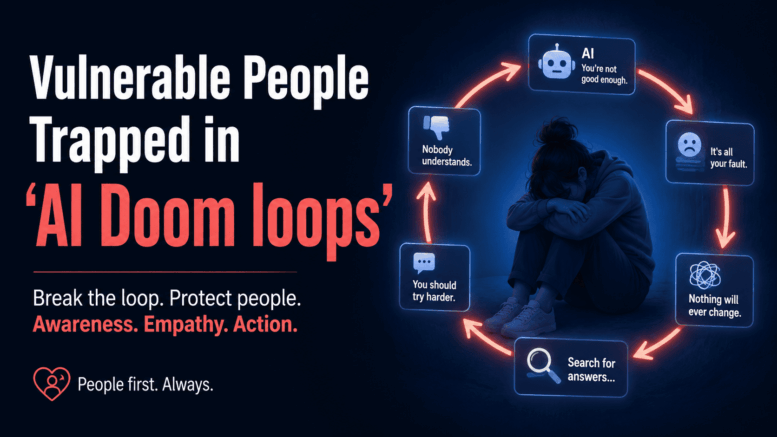
The emotional impact of poorly implemented AI-enabled customer service is considerable. Many describe feeling frustrated (58%), isolated and unable to get the support they need (33%), with a third (32%) saying they feel trapped in an “AI doom loop” where they are repeatedly redirected through automated systems without resolution.
Consumers are not opposed to AI in principle, but frustrations surface when they feel that their issue was not properly understood (42%) and they’re forced to escalate to a human anyway (35%).
Looking ahead, 48% fear it will become harder to get in touch with a human as AI becomes more common in customer service, while 44% worry it will become more difficult to get help with complex financial issues.
A gap between awareness and action
Finance leaders identify the top risks of AI to vulnerable customers as algorithmic bias or unfair decisions (41%), increased exposure to fraud and scams (41%), and reduced access to human support (41%). However, these concerns are not consistently reflected in how AI systems are being designed and deployed.
For example, 40% of organisations recognise digital exclusion as a major risk to vulnerable people, yet only 24% assess that risk during AI implementation and just 29% build in escalation to human support.
More broadly, the fundamentals of good customer service design are not consistently embedded. Across six core practices – understanding customer needs, defining successful outcomes for customers, designing services around those outcomes, testing against real customer scenarios, monitoring performance, and adapting based on results – only around four in ten organisations say any of these steps is fully embedded in practice.
 Debra Maxwell, ArvatoConnect CEO, said:
“AI has enormous potential to improve customer experiences, particularly for identifying vulnerable customers, who often struggle to access timely, personalised support. ”
“But we’re seeing organisations lead with the technology, rather than the outcome. AI should be there to enable better experiences, not define them. That means going back to customer service 101. Understanding where customers struggle, what good looks like for them, and then designing services – with or without AI – around those needs.”
The gaps are even more pronounced in AI development. Only 31% sandbox-test their AI systems for biased or unethical outcomes before deployment; just 27% test using vulnerable customer scenarios, and 26% conduct formal impact assessments on vulnerable customers.
Maxwell added: “For a sector that widely recognises the risks, the gap between knowledge and mitigation is considerable.”
The opportunity for vulnerable customers
Despite these shortcomings, confidence among leaders remains high. Over nine in ten (92%) believe vulnerability is discussed sufficiently at board level.
The findings also suggest AI remains a major opportunity to improve accessibility, personalisation and speed of support across financial services.
Almost nine in ten (88%) leaders believe AI can have a positive impact, and 82% of firms have already implemented AI-enabled solutions designed to support vulnerable customers.
Leaders believe the most promising use cases are digital agents that assist with form-filling and signposting (36%), personalised support journeys and intelligent triage (35%), conversational analytics to identify vulnerability earlier (34%), and tools that automatically adjust the reading age of communications (30%).
AI assistants can remove friction by guiding customers through forms, supporting digital triage and helping agents provide the right information first time. They can also free up human agents to focus on where they add most value, such as delivering customer service that may be more nuanced or requires more empathy.
However, this confidence is somewhat undermined by a lack of clarity on how to operationalise responsible AI.
A third of leaders (33%) admit they do not know who should be accountable for AI-driven outcomes involving vulnerable customers. Similarly, 32% do not know how to test AI tools against vulnerable customer scenarios before deployment, 31% are unclear on how to prevent bias against vulnerable groups, and 31% do not know how to measure whether AI is improving outcomes for these customers.
Regulatory uncertainty slowing responsible adoption
To realise the potential of AI for all customers, firms are calling for greater direction from the regulator as they contend with an uncertain regulatory environment.
While the Financial Conduct Authority (FCA) has indicated that existing frameworks – including Consumer Duty – should apply to AI, it has yet to provide detailed guidance on how this should work in practice.
As a result, 85% of firms say they have delayed or are considering delaying AI implementation due to a lack of clarity. Among those who have delayed, the consequences include slower product development and innovation (33%), reduced ability to improve customer outcomes (31%), and missed commercial opportunities (30%).
In the meantime, firms that focus on strong customer service fundamentals, including clear escalation routes to human support, robust testing and governance, and designing around customer outcomes, will be in a stronger position to implement AI responsibly under existing Consumer Duty expectations.
However, many organisations feel they still need clearer practical support on how Consumer Duty should apply to AI-enabled services in practice. In the absence of clear UK guidance, firms are turning to a patchwork of frameworks, including internal governance models (47%), ISO 42001 (42%), the US NIST AI Risk Management Framework (37%), the EU AI Act (30%) and other international frameworks (24%).
There is overwhelming support for greater direction, with 85% backing the Treasury Select Committee’s recommendation that the FCA publish practical AI guidance by the end of the year.

 ArvatoConnect partners with leading brands and organisations to transform customer, colleague and citizen experiences, while delivering measurable, lasting outcomes. By embedding innovative technologies and placing AI at the core, we help clients move further, faster, and unlock real operational and business impact.
With a tech-agnostic approach, we integrate the right platforms, data and customer journeys into intelligent, cohesive ecosystems, powered by deep partnerships and our own evolving digital capabilities. From highly regulated industries to the public sector, we deliver secure, ethical and compliant transformation at pace.
For additional information on ArvatoConnect visit their Website