New Research Sheds Light on the Risks and Realities of Fragmented Workforce Communication in the AI Era
Global survey of 2,000 workers and IT leaders, including 500 from the UK, offers a unique glimpse at the real-world effects and risks of communications breakdowns and misaligned tools, especially for frontline workers
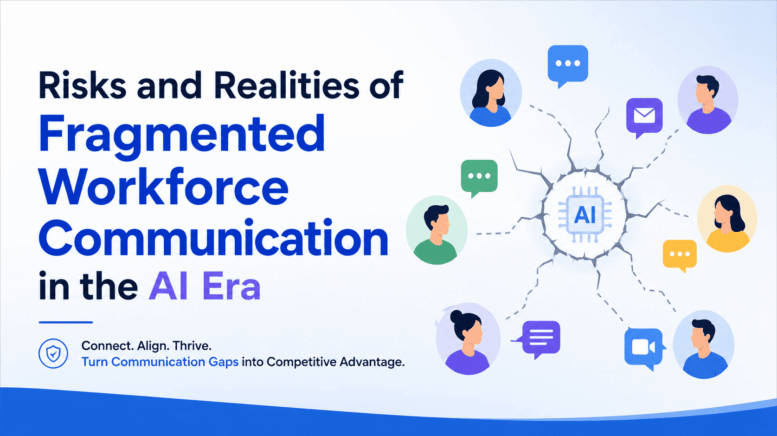
In the UK:
- 61% report wasting time switching between an average of seven communication tools
- 71% use non-approved communication tools for work-related purposes
- 71% of workers feel pressured to “make it work” with tools not designed for their needs
- Over two-thirds of workers (70%) believe their organisation does not adequately support AI use
 Mitel have released its State of Workforce Communication report. Based on research by Vanson Bourne, it reveals a significant gap in today’s era of widespread AI adoption. Revealing that while workplace communication is mission-critical, tools are misaligned with how teams execute, forcing employees to quietly compensate at measurable cost to productivity, security and service quality.
The research surveyed 500 IT decision makers (ITDMs) and desk and frontline employees in the UK, taken as part of a global survey of 2,000 respondents across diverse industries, including healthcare, public sector, retail, manufacturing, financial services and hospitality. It found that over two-thirds (71%) of UK workers feel pressured to “make it work” with systems that are not designed for their needs. This situation creates friction in productivity and service delivery while increasing operational and financial risks associated with limited control over data custody, performance and business continuity.
In parallel, 94% of ITDMs consider communication tools integral to everyday business operations, yet only 30% of workers say those tools are highly effective. This highlights a gap between how communication tools are deployed and how employees actually work.
 Eric Hanson, CMO at Mitel, said,
“Organisations are making significant investments in AI, communication infrastructure, and modernisation. Yet more than half of employees report that these tools fall short at the moments that matter most.~
“The challenge is not a lack of technology, but a lack of alignment with the realities of work. In fast-moving, high-pressure, and increasingly mobile environments, communication must be immediate, reliable and context-appropriate — or it risks breaking down precisely when it is needed most. What also emerges from this study is a simple but critical insight: control and employee experience are not competing priorities, but deeply interconnected ones. Closing the experience gap is now essential to reclaiming control and ensuring that communication investments translate into real-world performance and impact,”
Communication Tools are Failing a Mobile, Frontline Workforce
While 94% of IT leaders consider communication tools strategically critical, Mitel’s report highlights the complexity of delivering consistent, effective communication across a distributed, mobile, and frontline-driven workforce. 88% of UK IT leaders acknowledge that some parts of the workforce are better served by communication tools than others. This points to a gap between intention and reality that is reflected in the day-to-day experience of desk and frontline workers. Over seven in ten (71%) feel pressured to “make it work” when communication systems are not designed for their needs.
One of the key drivers lies in tool overload: the study reveals that workers are navigating increasingly fragmented communication environments, often relying on an average of seven disconnected tools to complete even routine tasks.
The Hidden Cost of Communication Gaps
Over half of workers (62%) say they waste time switching between communication tools and 50% of frontline workers feel increased pressure during busy or critical moments.
These inefficiencies extend beyond internal workflows, directly affecting service delivery, operational consistency, and, in some cases, safety. The burden is highest for frontline workers, where communication failures carry greater consequences. Over half (58%) of these workers report delays in completing tasks or responding to situations, 42% say that it impacts quality of service, and 28% even report that it creates safety risks for customers, patients, or staff.
These workarounds also introduce significant security risks to organisations. The report reveals that when faced with communication issues, workers are finding their own ways to keep work moving. Nearly three-quarters (71%) use non-approved communication channels for work-related purposes, increasing risks such as data exposure, compliance breaches, cybersecurity threats, and a loss of visibility and control, according to 93% of ITDMs. This behavior is even more pronounced among frontline workers, who are over twice as likely to use non-approved tools often to respond to their customers and patients quickly and effectively when sanctioned tools fall short.
Workers Embrace AI’s Potential, But Face Adoption Hurdles
While business leaders are prioritising AI investments to improve efficiency and modernise operations, adoption across the workforce remains uneven, and many workers feel unsupported. The report highlights that 51% of workers regularly use AI tools, but only 37% feel very comfortable using them in their day-to-day work. At the same time, 70% consider their organisation does not adequately support AI use, introducing a new emerging risk: Shadow AI.
This is evidenced by the fact that half of workers turn to non-approved AI tools, outpacing their organisations as they move to drive functional productivity and operational velocity. In the meantime, IT leaders indicate growing concerns around incorrect or misleading outputs (77%), whether AI use meets regulatory or compliance requirements (75%), and how data is stored, used and protected (72%).
AI is not yet delivering consistent value for the workforce, and managing its pace and risks remains a shared challenge for both IT leaders and workers. Clear guidance, integration, and alignment with existing workflows are needed to reduce complexity and risk rather than add to them.
Voice Stands Out as the Most Trusted Channel in Critical Moments
Messaging platforms remain the preferred choice for everyday collaboration, but voice becomes the most trusted and effective channel in urgent or high-stakes situations, across generations.
Nearly eight in ten workers (79%) rely on voice communication when rapid action and immediate alignment are required, highlighting the enduring value of real-time human interaction in critical moments. The trend is particularly pronounced among healthcare professionals, where communication speed can directly influence operational outcomes and patient care, with 56% adopting a voice-first approach during urgent situations.
The Path Forward: Flexibility and Control
To address these challenges and close the gap between investment and employee experience, organisations must reconcile two priorities: offering employees the flexibility to choose the communication tools and channels best suited to each situation while ensuring strong standards for security and compliance.
In this context, hybrid infrastructure became the operating reality: 85% of ITDMs already rely on it for their communication tools and 90% confirm that it provides the flexibility and control needed, without unmanageable complexities. This model allows organisations to modernise communication systems while maintaining oversight and stability across increasingly complex environments.
“While there is broad alignment between IT leaders and employees on the need to evolve workforce communication, this research underscores how far most organisations remain from achieving that objective. They must address foundational challenges while navigating increasing technical complexity, heightened security requirements, and ongoing modernisation efforts. These dynamics highlight the need for more practical, user-centered approaches—particularly solutions that are seamlessly integrated into everyday workflows across roles and work environments to ultimately drive performance and business outcomes,” said Luiz Domingos, CTO of Mitel.

To review the complete State of Workforce Communication report and findings Click Here
Mitel is a global leader in business communications, providing businesses with advanced communication, collaboration, and contact center solutions. With more than 70 million users across over 100 countries, Mitel empowers organizations to connect, communicate, and collaborate seamlessly, with the flexibility and choice they need to thrive, both now and for the future. Through proven experience and innovative solutions, Mitel delivers communications without compromise.
Survey Methodology: This study was conducted by Vanson Bourne on behalf of Mitel, and gathered insights from 2,000 respondents across five key global markets: the US, Canada, Germany, UK and France. Three respondent types were surveyed: IT decision makers, desk workers and frontline workers from organizations with 500 or more employees, working within a variety of key industries such as healthcare, manufacturing, financial services and the public sector.