The next challenge for contact centres isn’t deploying AI, it’s managing it – John Finch, Senior VP Marketing, RingCentral discusses.
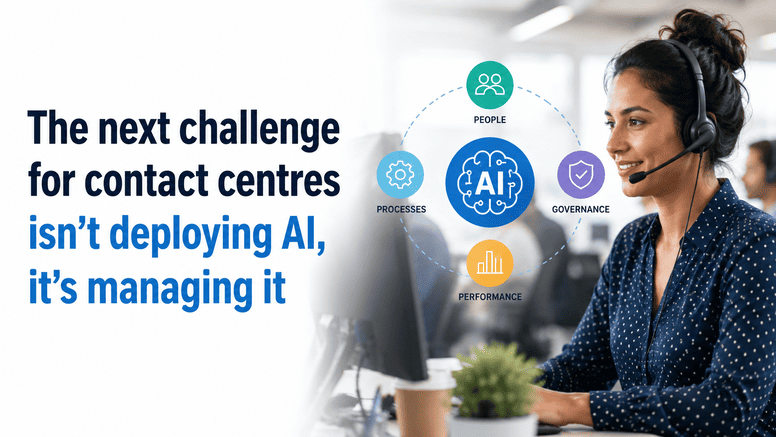
The biggest challenge facing contact centres isn’t deploying AI anymore. It’s managing it. As AI agents become capable of resolving customer queries, taking actions and working alongside human agents, success will depend on how quickly organisations oversee AI.
Organisations already using agentic AI are seeing the benefits, with 60% reporting productivity gains and 45% saying it has improved customer experience. Yet, the real competitive advantage won’t necessarily come from deploying more AI, it will come from knowing how to manage it.
The instinct for many organisations will be to automate as much as possible. That’s understandable, but it’s the wrong objective. The best contact centres won’t be the ones with the highest levels of automation.
Managing AI is about knowing when it should take the lead, when people should step in and how to measure its performance. Before deploying an AI agent, organisations will need to define the interactions it can handle independently, instances it should hand over to a person, and what policies it is authorised to apply. That means treating AI as an active part of the operation rather than another technology project. Supervisors will need visibility into how AI is performing, where customers are dropping out of conversations and when human intervention delivers a better outcome. Without these guardrails, businesses risk automating inconsistency rather than improving service.
AI is becoming another member of the contact centre team
One of the biggest misconceptions about AI is that it’s here to replace contact centre agents. What’s happening in practice is much more nuanced. AI is evolving beyond being a simple assistant that drafts responses or summarises conversations. It’s increasingly capable of resolving routine enquiries, completing workflows and taking action on behalf of customers.
AI is becoming another member of the operational team, but that doesn’t mean every customer interaction should be automated. A customer checking a bill or changing an appointment may never need to speak to an agent. But someone calling after multiple failed appointments, disputing a complex account issue that involves payments, or dealing with a particularly sensitive situation is looking for something AI can’t always provide, such as emotional judgement, reassurance and flexibility.
The challenge is that AI can also make mistakes, which are harder to spot than those made by people. An AI agent could repeatedly issue the wrong refund policy, fail to recognise when a vulnerable customer needs additional support or confidently provide incorrect information. Customers may not realise the AI has made a mistake at all. Instead, they may assume the response reflects company policy or the correct process, leaving them with the wrong outcome and ultimately damaging trust.
The challenge for contact centres isn’t deciding whether AI or people are better. It’s creating an operation where each complements the other, with conversations moving seamlessly between AI and human agents without customers having to repeat themselves or lose context. When that happens well, AI doesn’t replace the customer experience, it enhances it.
AI will help managers lead better contact centres
From a management perspective, contact centre supervisors won’t be responsible for coaching only human agents now. They’ll increasingly oversee teams made up of both people and AI agents, each contributing differently to customer outcomes. That means reviewing how AI agents are performing, identifying where they are making repeated mistakes, deciding when workflows need to be reassessed, setting escalation rules and ensuring AI continues to follow company policy and compliance requirements.
Instead of relying on small samples of customer conversations for analysing conversations, contact centres can understand what is happening across every interaction. They can identify the questions AI resolves confidently, the common points when customers repeatedly ask to speak to an agent, what types of issues cause unnecessary handovers, and where customer journeys begin to break down. Those insights are what make AI manageable. Traditional contact centre metrics such as resolution rates no longer tell the full story.
An AI agent might resolve a conversation without ever passing it to a person, but that doesn’t necessarily mean the customer received the right outcome. That’s why organisations need to look beyond traditional contact centre metrics and measure whether AI is actually improving customer experience, not just resolving conversations. Take an AI agent that successfully resolves almost every password reset but struggles when customers ask follow-up questions about fraud. That’s not a failure of AI, it’s a management opportunity. Those insights allow supervisors to refine workflows, improve handovers and decide whether those conversations are better handled by a person or by AI.
This changes the role of the supervisor from reactive to proactive. Instead of relying on hindsight, they’ll have richer insights into customer conversations as they happen, helping them improve service quality, support agents more effectively and make faster operational decisions. AI tools now offer conversation analytics and supervisor insights that help contact centre leaders spend less time gathering information and more time acting on it.
Every conversation becomes a feedback loop, helping organisations refine how AI responds, improve workflows and identify where human expertise continues to add the greatest value. Rather than treating AI as something that’s deployed once and left alone, contact centres can continually measure, adapt and improve how it performs.
The future of contact centres is managed AI
Success won’t come from having the most advanced AI model or the highest levels of automation. It will come from knowing where AI delivers the best customer outcomes, where people add greater value and giving managers the visibility to improve both over time.
Importantly, customers shouldn’t have to think about who’s helping them. Whether a conversation starts with AI, moves to a human agent or switches between the two, the experience should feel seamless. Context should be carried across automatically, meaning customers don’t have to repeat information or start their journey again.
As AI becomes another member of the contact centre team, managing its performance will become just as important as deploying it in the first place.

 John Finch is Senior VP Marketing at RingCentral