How AI is turning accessibility into a customer experience advantage – Sarah Backhouse, Product & Engineering Director (Digital Experience) at Netcall discusses.
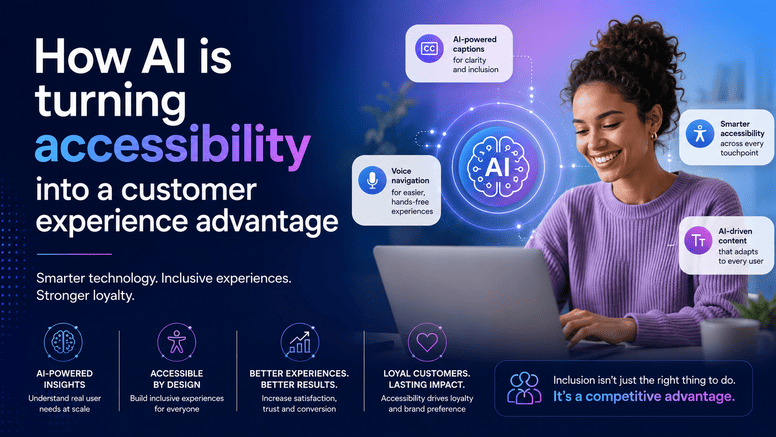
For years, organisations have expected people to learn their language. Whether it’s council terminology, healthcare jargon, financial services language, or internal company labels, users are expected to know what they’re looking for before they start searching.
Websites are typically structured around departments and processes, rather than the way people naturally think.
Most people arrive at a website with a question, not a category. They don’t know which department owns the answer or the organisation’s terminology. They simply want information quickly and easily, using their own words. Yet many digital experiences still place the burden on the user. If they get the wrong search term, they need to navigate multiple pages, try different phrases, or abandon their search altogether.
As digital becomes the primary channel for customer interaction, the gap is becoming costly and hard to ignore.
Expectations have shifted too. Conversational AI has conditioned people to expect digital experiences to work in the same way they communicate. They want to ask questions naturally, use voice input, and receive direct answers. They don’t need to understand how an organisation is structured behind the scenes.
This shift presents a significant opportunity, particularly when it comes to accessibility and digital inclusion.
Moving beyond compliance
Accessibility has traditionally been viewed as a compliance issue. Organisations have rightly invested significant effort in meeting standards and making digital services available to as many people as possible. That work remains important, but it has a ceiling. Today, accessibility is becoming part of the overall experience people have with an organisation. A service can meet every technical standard and still be practically unusable, because the terminology is opaque, the journey is convoluted, or the search requires insider knowledge to operate.
Digital inclusion addresses what compliance misses. A non-English speaker, someone who finds typing difficult, a user unfamiliar with industry jargon, or someone lacking confidence to navigate complex digital journeys.
Different scenarios, with the same results. People cannot find what they need, and organisations fail to serve them effectively.
Why AI changes the conversation
Much of the discussion around AI focuses on productivity gains, automation, and efficiency.
Less discussed is AI’s potential to make information genuinely accessible to more people. Instead of expecting users to think like organisations, organisations can use AI to start responding to the way people naturally communicate. Someone can ask a question in their own language and receive a relevant answer without having to understand the structure sitting behind the website.
Conversational search, natural language processing, voice interaction, and real-time translation allow users to engage with digital services in a way that feels natural to them, rather than a list of links that assumes they already know where to look.
Traditional keyword search relied on users to guess the right phrase, understand organisational structure, and refine their searches until they find something that works.
AI-powered search, on the other hand, interprets intent and context. The practical difference is significant. Instead of asking people to search across multiple pages or systems, AI can bring trusted information together and present a single, relevant answer.
Digital inclusion by design
The organisations getting this right treat digital inclusion as a foundational design decision rather than a retrofit. That means considering there is no single user journey that works for everyone and building accordingly.
For example, in organisations serving increasingly diverse communities and customer bases, language can be as much of a barrier as accessibility. AI-powered experiences can reduce that barrier by allowing people to ask questions in their preferred language and receive answers they understand.
Voice interaction is another way of improving inclusion, with improvements rarely confined to the group they were designed for. It helps users with physical difficulties such as visual impairments, as well as busy people on mobile phones or with literacy or learning difficulties. Another group to benefit is the elderly, or those less confident with digital devices, as they often find speaking a request quicker than typing. Meanwhile, real-time translation supports non-native speakers but also improves access for international customers. Conversational search helps users unfamiliar with jargon, whilst creating a faster experience for everyone else.
This is why digital inclusion should no longer be viewed as a niche concern. For many industries, including the public sector, accessibility has become a legal requirement, with guidelines becoming more prominent in others. Ultimately, it is becoming central to the way organisations design modern customer experiences, whilst also helping them make better use of their resources.
As Simon Fletcher, Chief Executive at Lichfield District Council, explains, “By introducing AI-driven search, we’re able to deliver tailored, accurate answers, making it easier for residents to get the help they need, quickly and efficiently.
“Our key aim is to ensure those customers who are happy to self-serve can find what they need quickly and remain online, without the need to phone us, leaving us more time to provide tailored support to customers who need extra help.”
Designing around people, not processes
The next step for customer service organisations: make digital services work better for the people using them. Reducing friction and lowering the barrier to finding information means a more effective experience for a broader population, not just those with accessibility needs.
In a world where customer experience and digital inclusion are becoming increasingly connected, AI offers organisations the opportunity to rethink how people access information and services. Those that use it to make interactions simpler, more intuitive, and more inclusive are likely to see the greatest value.
fend, explain, and scale. That’s how you move faster – without compromising what matters most.

 Over 600 organisations in financial services, insurance, local government and healthcare use Netcall’s Liberty platform to make life easier for the people they serve.
Liberty Converse is the next-generation, AI-powered contact centre solution that redefines how businesses engage with their customers. The cloud-native platform extends its robust contact centre software capabilities to harness the power of intelligent process automation and rapid application development, setting Netcall apart in the competitive landscape.
Liberty Converse is part of Netcall’s Liberty platform which provides cut-through process automation and communications solutions, helping organisations to achieve their business goals faster in a rapidly changing world. Liberty offers user-friendly, AI-driven tools to create business applications that automate processes, streamline workflows and enhance both customer and employee experiences.
For additional information on Netcall view their Company Profile