AI spending is rising faster than measurable CX returns – With AI investment across customer experience reaching unprecedented levels, it’s not foolish to expect businesses to be seeing some level of return on their investment. However, recent reports show this isn’t always the case.
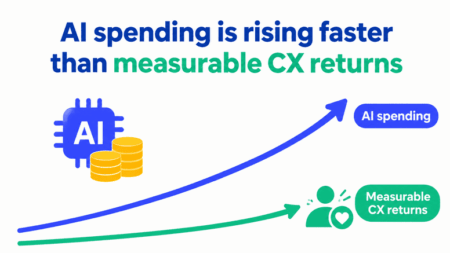 In fact, new research from CCW Europe shows that 57% of CX leaders have seen limited or no impact from AI over the past year, while only 11% report significant or enterprise-level results. Despite this, 62% expect to increase AI investment over the next 12 months, with 17% anticipating budget growth of more than 25%. This raises the question: are organisations investing more because AI is delivering value? Or is it the case that they believe further spending will fix underperforming areas within the business?
In many cases, the problem is not a lack of ambition. It is more a lack of precision. Contact centres are scaling AI before identifying the right use cases, success measures or model architecture. As a result, costs can rise through additional compute, orchestration and operational complexity without a corresponding improvement in customer satisfaction, handling time or cost to serve.
 Dmitry Sityaev, Head of AI at Connect, believes CX leaders now need to focus less on the size of their AI budgets and more on whether they are using the right model for the right task. In particular, small language models (SLMs) can offer a more practical route to measurable returns in structured contact centre environments.
Why AI investment is failing to translate into CX impact
AI certainly has a role to play across most industries, and contact centres are no exception. While it has the potential to improve performance significantly, the reality today is that cost savings are far from guaranteed.
Of course, in 2026, it’s difficult to find a business not using AI in some form in an attempt to reduce operational costs and improve efficiency. However, poorly implemented AI deployments can add another layer of expenditure before they remove existing costs. LLM compute, orchestration infrastructure and operational inefficiencies should sit alongside the human workforce rather than replacing it. Of course, these challenges become more pronounced as deployments scale, with even small inefficiencies in precision, latency or orchestration quickly adding up across millions of customer interactions.
This means the discussion should no longer centre solely on whether AI is capable. That has largely been proven. The more important question is whether the chosen architecture improves core contact centre metrics in proportion to the cost and complexity it introduces. If it doesn’t, increased investment risks increasing the scale of the problem rather than the scale of the return.
The problem with using large models for every interaction
Large language models (LLMs) are undeniably powerful. Many contact centre journeys are structured and predictable. Identity verification, balance enquiries, appointment changes and policy updates require speed, precision and reliability rather than open-ended reasoning. Applying large, general-purpose models to these high-volume, low-complexity tasks can introduce unnecessary compute and energy requirements.
Latency also matters. Even small delays in a voice interaction disrupt natural turn-taking and can increase average handling time. At high volumes, a few additional seconds across each interaction can have a material effect on cost to serve. This is why model architecture is becoming a commercial strategy, not simply a technical design decision.
The case for right-sized, orchestrated AI
A more effective approach is to align the complexity of the model with the requirements of the task. The goal is therefore not to replace LLMs with SLMs, but to orchestrate different models according to the task. Micro-models can handle atomic, precision-based activities; SLMs can manage structured workflows and orchestration; and larger models can be invoked when deeper reasoning, contextual interpretation or emotional nuance is genuinely required.
Smaller models also require less computation. In structured customer journeys, that can translate into faster processing, shorter interactions and more predictable operating costs. Additionally, SLMs can be trained around the specific requirements of a contact centre or industry. In sectors such as healthcare and financial services, for example, models can be trained to recognise relevant terminology and route customers to the appropriate AI or human agent.
They can also be trained and fine-tuned using relevant contact-centre interaction data, helping models better understand the terminology, interaction patterns and operational context specific to the organisation. This doesn’t mean moving away from LLMs altogether, but using them more selectively. Larger models still have an important role where deeper reasoning, contextual understanding or emotional nuance is needed. For simpler tasks, however, organisations should consider whether that level of computational power — and the associated cost — is really necessary.
Using specialist models for high-volume, precise tasks
Identification and Verification elements in contact centres illustrate why micro-models can manage atomic, precision-based activities. According to ContactBabel 76% of inbound contact centre calls require ID&V and 91% of those are still completed by a human agent.
General-purpose large language models are designed for broad conversation, but these processes demand almost the opposite. One incorrect character can cause the process to fail. Specialist micro-models can instead be trained specifically for alphanumeric entity recognition. Rather than asking a general-purpose model to perform a task it was never optimised for, the organisation uses a model built to perform that task accurately and quickly.
The benefit extends beyond authentication itself. Successful ID&V can remove a major barrier to downstream self-service, creating opportunities for shorter queues, lower abandonment, reduced average handling time and more capacity for human agents to focus on complex interactions – ultimately saving the business money in the process.
Conclusion…
Ultimately, AI investment needs to be measured against the same outcomes contact centre leaders are already responsible for. Does it reduce cost to serve? Does it improve average handling time? Does first-contact resolution increase? Is containment improving? And, crucially, is the customer experience getting better?
AI architecture directly influences each of these outcomes. Precision affects containment and first-contact resolution. Latency affects handling time and customer experience. Compute requirements influence cost. Governance affects risk and control. Orchestration determines whether organisations are paying for deeper intelligence only where it creates value.
For CX leaders preparing to increase investment again, the priority should be to understand exactly where that additional spending will improve performance. The organisations seeing stronger results will therefore be those that apply AI with greater discipline, rather than those that simply deploy the largest models or commit the biggest budgets.

 Connect is a global CX systems integrator and AI-led digital transformation partner. We help organisations modernise customer journeys and optimise service operations across every touchpoint, applying AI where it delivers measurable operational value.
Our differentiation lies in the experience we’ve gained from operating CX in the real world. Our approach is grounded in real-world CX operations, ensuring AI and automation deliver measurable impact.
We design, deliver and optimise contact centre and CX platforms, combining architecture, data-driven insights and applied AI to operationalise AI in CX at scale. This reduces risk, accelerate value and avoids the common failure modes of CX transformation: prolonged programmes, platform lock-in, and change initiatives without measurable outcomes.
Our vision is to be the world leader in technology‑enabled customer experience, delivered through a service‑led, customer‑centric approach.