Technology Advances in the Contact Centre Industry Over the Past 25 Years – I was reminded recently that contact-centres.com has been published for over 25 years which got me thinking.
So how has the contact centre advanced over a quarter of a century?
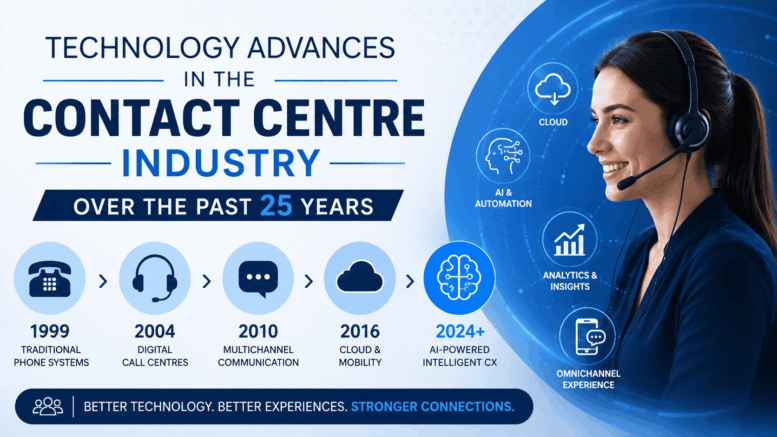
Over the past 25 years, the contact centre industry has undergone a remarkable transformation, driven by rapid technological innovation and changing customer expectations. What was once a phone-based operation relying on on-premise hardware has evolved into a sophisticated, cloud-powered customer engagement hub.
In the late 1990s and early 2000s, contact centres primarily focused on voice communications, with agents using desk phones connected to private branch exchange (PBX) systems. Customer interactions were often limited to telephone calls, and reporting capabilities were relatively basic.
The introduction of Voice over Internet Protocol (VoIP) and cloud technology revolutionised the industry. Organisations were no longer tied to expensive on-site infrastructure and could deploy flexible, scalable contact centre solutions accessible from anywhere. This shift also enabled remote and hybrid working models, which became essential during the COVID-19 pandemic.
Another major advancement has been the rise of omnichannel communication. Today’s customers expect to interact with businesses through phone, email, live chat, SMS, social media, and messaging apps, with seamless transitions between channels. Modern contact centre platforms bring these interactions together into a single interface, giving agents a complete view of the customer journey.
Artificial Intelligence (AI) has further transformed customer service. AI-powered chatbots, virtual assistants, intelligent call routing, sentiment analysis, and real-time agent assistance now help organisations improve efficiency while delivering faster, more personalised experiences. Advanced analytics also provide valuable insights into customer behaviour, enabling continuous service improvement.
Automation has reduced repetitive tasks, allowing agents to focus on resolving more complex enquiries. Meanwhile, stronger cybersecurity measures, including encryption, multi-factor authentication, and compliance tools, have become essential as organisations handle increasing volumes of sensitive customer data.
As technology continues to evolve, contact centres are becoming strategic business assets rather than simple support functions. By combining cloud platforms, AI, automation, and data analytics, today’s contact centres deliver faster responses, improved customer satisfaction, and greater operational efficiency than ever before.
The Editor